Monday, May 18, 2015

Blog Post 9: Course Reflection

What did I get the most out of this course?
  • The first thing that comes to mind is the MDA framework, especially how designers and the audience approach games from different ends of the spectrum. This was probably my biggest takeaway, and it'll definitely help me be more conscious of the audience when I design games from now on.
  • I also learned exactly how games can lack substance but still keep people playing through gamification and the skinner box method. While not the best method, it helped to explore design ways of how to keep people hooked.
  • Paper prototyping was also really helpful because it taught me that design is independent of programming, and that you can still iterate on an idea without having to write a single line of code.
  • It was also helpful seeing games used for a variety of purposes, such as letting players experience something that they normally would never be able to (Auti-sim) or turning the world into a giant game space and forcing you venture out into it (Ingress).
  • In terms of my final specifically, it helped me quickly learn a lot about Unity and also forced me to bring a game to a playable state in a timely manner. Getting to playtest it in class allowed me to gauge other's reactions and playstyles and edit as needed.

Friday, May 1, 2015

Blog Post 8: Final Project Pt. 1

The Idea

I had downloaded this program called Virtual Desktop for Oculus, which takes your desktop and projects it in virtual space. From there you can scale the size however you like, so it's probably the cheapest way to get a wall-sized screen. 

The thing about this program is that it had a setting for screen curve. This curves the screen around you and is intended to make text easier to read. (The Oculus doesn't have the highest pixel density.) However, the slider went all the way to 360 degrees. 

Naturally, my first instinct upon discovering this was "I could totally use this to cheat at video games."

There's a level in VVVVVV that wraps the screen around pacman-style. The stage's challenge comes from taking what would be straightforward platforming and messing with it spatially. It forces the player to think around the screen wrapping in order to make jumps.

However, I thought, if the ends of the screen met, the stages would be easier! The 360 degree screen curve turned something like this:


 Into this:

However, a problem arose: the game was pretty much impossible to play. The screen wrapped around, sure, but it wrapped in a full bubble around you. This made the stage huge, and I had to crane my head around just to find the character respawn whenever I died. Plus, since both the character and gameplay are fast, trying to platform on a stage larger than my field of vision had me inching along.

But, it gave me an idea. What if there was a platforming game that wrapped around like this, but was built with the Oculus in mind?

Making the Game

The game pretty much made from parts of other projects I started. The tileset was taken from when I tried to create a base for prototyping platforming games, and the Oculus prefabs I was already used to working with for another project that's proven way too ambitious for now. 

The stage is just set up as a really long 2D stage:


A 2D camera is pointed at it, and projects onto the inside of a cylinder. I had to model the cylinder myself, since the default cylinder in Unity projects textures on the outside.


The Oculus camera is placed in the middle of this cylinder:


Since trying to get the character to wrap around the 2D plane looked like a bit too much work to code, I just designed the game around that limitation. I placed a giant tower at both ends of the stage so that it blocks the player from wrapping around.

The game is set up like a tower defense game. You have a small house in the middle, and on the opposite end of the stage is a big evil tower that spawns enemies. The enemies travel down both sides of the stage to attack the house, and the player has to defend from them.

Currently I have:
  • A basic layout of the stage
  • Jumping! 
  • Basic AI. Right now I've coded it to just travel towards the house.
At the bare minimum, I still need:
  • Enemy spawning
  • Enemy attacking (the house)
  • House health 
  • Enemy heatlh
  • Player attacking


Monday, April 20, 2015

Blog Post 7: Ingress

Today in class we all went out into the world to play Ingress.


The controls got a little getting used to, but soon I was just casually hacking every portal I walked past.

The group experience was interesting. It was helpful to have a group of people be a resource, so we could ask each other what something did or what to do next. On the other hand, our out-loud planning didn't make us all that conspicuous.

Actually, it's pretty tricky to be conspicuous. Most of the time I found myself looking at my phone instead of where I was walking, even after we all disbanded. Though I guess that may not be -too- out of the ordinary on a college campus.

We tried to coordinate attacks, but I could never really gauge how well we were doing. (That might have to do with us all being level 1, though.)

At one point we tried to attack a portal with only one resonator on it. We seemed to be doing well until suddenly that portal gained 3 more resonators. We looked around for other players and eventually spotted a small group standing in a nearby parking lot (the one by the ATMs). We cursed at them, but I don't think they heard us.

Later on we ended up finding another group of blues and formed a giant blue blob, cutting our way through campus. We didn't really wreck much shit, though -- at least, not from my perspective. I was just hacking portals left and right. We eventually did manage to snag a neutral portal, though. Soon after we all disbanded, though still playing on the way to the parking garages.

Monday, March 2, 2015

Blog Post 4: Video Game Lab


This Is The Only Level


This is a game that, as the title says, only has a single level.

Well, "level" as in a stage with platforms and spikes and a button and a start and finish. But the game had different "levels" in the sense that each time you completed the stage, some game mechanic would change. And this change would also change the whole dynamic for solving the stage.

For example, the game starts off straightforward: hop across some platforms, hit a button to open a door, and then exit the stage.

In the next stage, though, the game would reverse the controls on you. The player, naturally hitting right, would end up heading left into the spikes. This essentially signals to the player, "hey, we're messing with you now."

It was pretty interesting to see how a change in mechanics can greatly alter the player's view on the level. In one stage, the player can only jump using the spikes, which changes the dynamic from avoiding spikes into having to seek out spikes.


Canabalt 

The mechanics for this game were pretty straightforward: jump. Just jump. you don't even have to move, the game does that for you. You automatically run, you just need to jump to avoid the obstacles.

One interesting mechanic is that the longer you can dodge obstacles, the faster you speed up. One dynamic that I've seen develop out of this is that the player will intentionally hit obstacles in order to slow themselves down, giving them more time to react to harder jumps.

When my partner played this game, one thing I noticed is that the game is so fast-paced that those just starting out might not be able to pick up on everything happening on screen. For example, at one point a robot landed right in front of my partner, but it was really hard to catch, so she ran right into it. The game designer seems to understand this difficulty, because every time you die the game over screen will tell you why you died.


Super Puzzle Platformer


This game had interesting mechanics. It took the traditional Tetris / tile-matching style game and blended it with 2D platformer controls. An interesting dynamic the game had was the balance between line-clearing and staying alive. Since your character is standing on those blocks, and underneath those blocks are spikes, clearing a block you're standing on drops you into the spikes. So players had to make sure that the block they're shooting is not one that will clear underneath them -- creating another layer of strategy.


Jurassic Heart


This game was a pretty straightforward dating sim mechanics-wise, except the target of your affections happens to be a T-Rex. Most of the enjoyment we got was just from the absurdity of the situation. However, we got a bad end early on and moved on to the next game.


QWOP


This is one of those styles of games where the challenge is entirely created by crappy physics controls. There are just 4 keys: Q, W, O, and P, hence the name. Each key is assigned to a section of the leg; Q and W control the thighs, while O and P control the calves. The main challenge is finding the right rhythm with which to press them. After that, the challenge becomes keeping that rhythm and yourself upright.

Monday, February 23, 2015

Blog Post 3: Paper Prototype

This game is like a watered-down chess played on a modular board. The main mechanic is to place down tiles to reach your opponent's king, while they try to counter it by blocking off your path, and vice versa.
Session 1
  • On the very first game, we tried the tile placement mechanic without any pieces, just to see if the pieces were even necessary. The player would start from a single point on their side and try to work their way to the opponent's side of the board. The problem with that showed itself almost immediately:

  • With no real mechanic to counter the wall, we decided try now with the pieces.
  • The initial rules were as follows:
    • 6x6 board
    • 1 King
    • 2 Scouts
    • 3 Soldiers
    • Scouts "discover" tiles.
    • Soldiers recapture enemy tiles.
    • The only killing allowed were soldiers killing the king to win the game.
  • I don't remember if I had thought about this beforehand or if we hashed it out a bit during the game, but by the end of this first match it was established that a player can move multiple pieces during their turn, but each only one space.
  • During the first game, we realized that after all the tiles had been placed on the board, the scouts were now functionally useless.
    • Another problem was no killing meant that whoever started first had the better advantage.
    • Also, we were still having some stalemate issues.
  • The revisions we made were:
    • The ability to reclaim tiles was transferred from the soldier to the scout.
    • Soldiers now had the ability to kill scouts.
  • The next game we played was a little rough because I wasn't yet used to thinking around soldiers that can kill, so I ended up losing a scout or two.
Session 2
  • In this session I had a bit more difficulty explaining the rules.
  • One rule I had to make clear was that that there was no diagonal movement in this game. My opponent's game had diagonal movement, hence the confusion.
  • My opponent asked me questions about the king I hadn't thought about.
    • Can the king move? Since I thought this would make the game slightly more strategic, I said yes.
    • Can the king kill? I figured that might be too overpowered. No.
  • At one point we reached a stalemate: all the scouts were dead and there wasn't enough of a path for our  soldiers to get to each other's kings.

    • To resolve this, I tried a something I had been thinking about for a while: changing the ratio of soldiers and scouts.
    • Now there were 3 scouts and 2 soldiers per team.
  • This change helped immensely, as the following game we played went on for longer and allowed for more thoughtful strategy.

Session 3
  • This session I played with my brother. During the game he said he had a bit of experience with chess, so the mechanics of the game were pretty easy to explain.
  • We only played one round, and it went on for the longest out of all my play sessions. This is good, as I want the game to take enough time that there's room for power shifts, while at the same time not being a 4-hour waiting game.
  • He caught onto the dynamics very quick, and was very aware of the placement of his scouts in relation to my soldiers.
    • He also picked up on the "sacrifice a scout so the soldier behind it can move next to the king" strategy all on his own.
  • Only one question came up during the session: if a soldier kills, can it still move?
    • I imagined the difference between "yes" and "no" was negligible, but you never know, so I just picked yes to see how that would play.
      • This is one of those problems that you can only find the answer to by playing the "yes" path a bunch of times, playing the "no" path a bunch of times, and seeing how they compare.
      • Needless to say, I haven't tested it enough to know the answer.
  • Also, I got a lot of pictures out of this session. I ended up snapping one every 4 turns or so.
First 4 turns. (I'm black, he's white.)

Both sides meet.

Wall on the bottom but a scout sneaking through on top.

Many turns later. He's pushed forward on the bottom but now I have his king surrounded.

Chasing the king to the top. As you can see he's down one scout.

Cordoned off the king. He has three spaces to move the king, while I only have two soldiers. If that continues, he can jump around almost indefinitely to avoid my soldiers.

I use a scout to take away one of those spaces. At this point I've essentially won, and we call it game.

Wednesday, February 11, 2015

Blog Post 2: Board Game Session Report


Our group played Betrayal at House on the Hill. The game has two phases; in the first phase, players explore a house by wandering into unknown rooms and drawing room tiles from a stack. Room tiles can hold Item, Event, or Omen cards. If a player draws an Omen card, they must make a Haunt Roll-- a roll of 6 dice. (Dice in this game only have 0, 1, or 2 points.) If the number rolled is greater or equal to all the omen cards drawn during this game, you're safe. But if it's lower, the game shifts into the second phase.

In the second phase, depending on what the omen card was and where it was drawn, the players now have to deal with one of the game's 50 scenarios. In this phase, one player is revealed to be the traitor (nobody knows who the traitor will be until the second phase, not even the traitor), and now has a secret objective to meet. The remaining players must also meet their own secret objective.


My character's stats. Each player has 4 stat categories that can raise or lower based on various events.


The first play. Speed determines how many tiles you can move in a turn. If a room makes you draw a card, though, your movement ends there.

  • On my first turn, I wandered into the dining room. There I found a girl, who boosted my knowledge and sanity, and I then made a successful Haunt Roll.
  • A turn or two later, I found myself in the graveyard. There I drew an oddly fitting funeral card, and soon I had visions of myself in the casket. Fortunately I saw through them (sanity roll), and ended up gaining 1 sanity as a result.
  • At one point in the game, somebody finds a chapel room, which allows everyone to regain 1 sanity point per game. Since I have been the most sane person this whole game, I don't really need to go there. Everyone else, though, is dangerously low on sanity, and all rush there immediately.
  • As time goes on I notice we've been extremely lucky this game. All of my encounters so far have used only sanity checks. Andre, who has the fastest character, has been hitting a lot of speed checks. Jerika has just been finding a lot of items. We’ve also been dodging a lot of haunt rolls. (I forget the exact number, but I believe we made it up to 7 omen cards before finally losing the roll.)
  • I travel upstairs and find the Mystic Elevator, which is a sort of free-floating room that allows me to connect to any unexplored doorway. The destination floor is decided by a roll.
  • I end up in the basement.
  • Mind you, I'm actually pretty excited by this. There are no stairs into the basement, which means 2 things:
    1. At this point in the game, there's no way in or out except for the Mystic Elevator. There's something cool about having my own secret space.
    2. I can grab items without anyone bothering me. Not that they'd bother me anyway, I mean, we're all on the same team... right?
  • It doesn't take long for the secret adventure to be cut short, though. Two rooms into the basement, I find a Mask. I make a Haunt Roll. I fail a Haunt Roll.


Shit.

  • Because I found the Mask in the Catacombs, we are assigned scenario #25: Voodoo.
  • Except Maaike just played that scenario not to long ago. Because of this, we decide to skip to the next page, #26: Pay the Piper.
  • Devon is found to be the traitor. We send her out with the Traitor's Tome while we read our own Secrets of Survival
  • A few minutes into reading the objective, I realize that we possibly just jumped to a scenario that assumes there are cards or rooms in play that actually aren't. Maiike double-checks the requirements and assures me it's fine. (We later learn that the rules actually include a proper method for choosing another scenario if there are repeats.)
  • Everyone comes back and the second phase begins.
  • Scenario 26 involves one person controlling twice as many rats as there are players. Because there's a bucketful of tokens, Maiike decides it easier to just grab the first 10 monster tokens instead of wasting time fishing for rats.


Ah yes, the tentacle rat.

  • We start killing rats. They're pretty weak.
  • About halfway into her rat stock, Devon realizes that she can, technically, use her Adrenaline Shot (which allows you to add 4 or so points to a roll) on her rats. 
  • Andre goes in to a room to fight two rats at once. This is the most tense part of the second phase.
  • Unfortunately, the adrenaline doesn't help. A lot of the dice end up blank.
  • As we continue to massacre the rats, the traitor tries completing her objective, which is to find the pentagram room and perform a ritual in it. She explores as much of the ground floor as she can.
  • Soon, however, all the ground tiles are dispensed--and the pentagram room is among none of them (which means it's either in the basement or the second floor).
  • Not long after that, though, all the rats are disposed of, and the survivors successfully escape the creepy rat house.

Wednesday, January 28, 2015

Blog Post 1: Internet Arcade Game


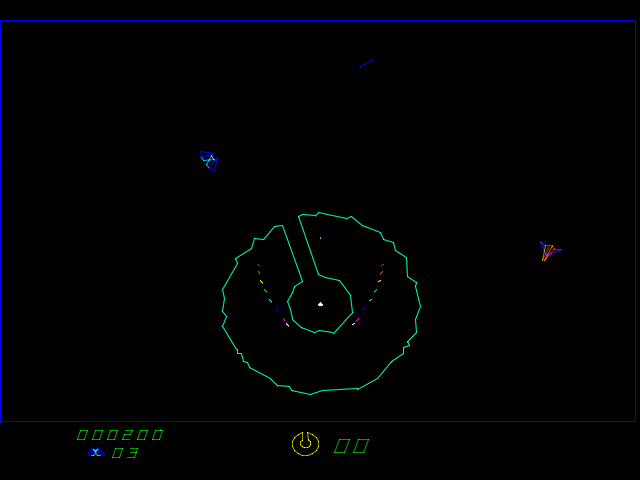
I decided to adopt a game called Eliminator: https://archive.org/details/arcade_elim2
I mainly chose this because it looked the most similar to a space shooter project that I'm working on and I thought I could draw ideas from it.

The first thing I did when playing this game was try to figure out which keys were supposed to be the usable buttons. I pressed all the keys on the keyboard, and tried to play with the ones that were responding, but I died pretty quickly. I then found out I could remap the controls with the tab key.

Even with my remapped controls, though, I still found that making any kind of progress on this game incredibly difficult. There are four main buttons: rotate left, rotate right, thrusters, and fire. The main challenge I had with this game was the disconnect between your ship's orientation and the screen's. Usually in 2D games, left means left on the screen, and right means right on the screen. In this game, however, pressing left only rotates and could take you in any direction.

Another difficulty I had playing this game is that it I found myself just inching the thruster along just to make sure I didn't run into anything. I would try to line up with the corridor of the giant asteroid base (the eponymous Eliminator) and finesse the angle of entry. The time I took try to do this, though, usually lead me to get bumped by the opposing ship's blaster right into the Eliminator and die.

In terms of playing this game on an emulator, it was nice having infinite credits to try out this game with, and I also like that they emulated the fuzzy pixels of arcade cabinets along with the game. However, like I mentioned before, I had to spend some time setting up the controls instead of just popping in a few tokens and pressing start. Also, this game took up maybe one-fourth of my laptop screen, as opposed to the full-screen immersion that standing in front of an arcade cabinet can give you.